Why Nigeria Must Learn the Difference between Silence and Nationhood
Anietie Udobit, Abuja
Grow your business with us

There is a growing tension in Nigeria’s public conversation. Increasingly, calls for unity are met with suspicion. To some, speaking about national cohesion sounds like an attempt to minimise suffering. To others, appeals for peace appear to excuse poor leadership or ignore injustice.
This misunderstanding deserves careful examination because it risks creating another crisis—one that no security operation or election can easily resolve.
Unity is not silence. Neither is it surrender.
A nation committed to unity does not deny insecurity. It does not ignore economic hardship. It does not dismiss the frustrations of citizens who demand accountability. Rather, it insists that these challenges be confronted without turning Nigerians against one another.
This distinction is becoming increasingly important as political activities gradually intensify ahead of the 2027 general elections.
History suggests that election periods often amplify existing divisions. Ethnic identities become political tools. Religious differences become campaign strategies. Regional loyalties sometimes overshadow national priorities.
The danger is not political competition itself. Competition is healthy in any democracy. The danger lies in allowing competition to destroy the relationships upon which democracy depends.
Nigeria’s greatest strength has never been uniformity. It has always been diversity held together by a shared commitment to nationhood.
The country has endured military rule, democratic transitions, economic shocks, and security crises.
Its resilience has always depended on citizens who refused to let disagreements become permanent fractures.
Today, that resilience is once again being tested. Can Nigerians insist on justice without embracing revenge? Can citizens demand better governance without embracing narratives that permanently divide communities? Can public debate remain vigorous while preserving mutual respect?
These questions matter because nations rarely collapse simply because problems exist. They weaken when trust disappears. When dialogue becomes impossible. When fellow citizens begin seeing one another as enemies rather than partners in solving common problems.
A secure, prosperous Nigeria cannot be built on suspicion alone. It requires trust. It requires institutions worthy of confidence. It requires leadership worthy of followership. And it requires citizens willing to place the country’s future above temporary political victories.
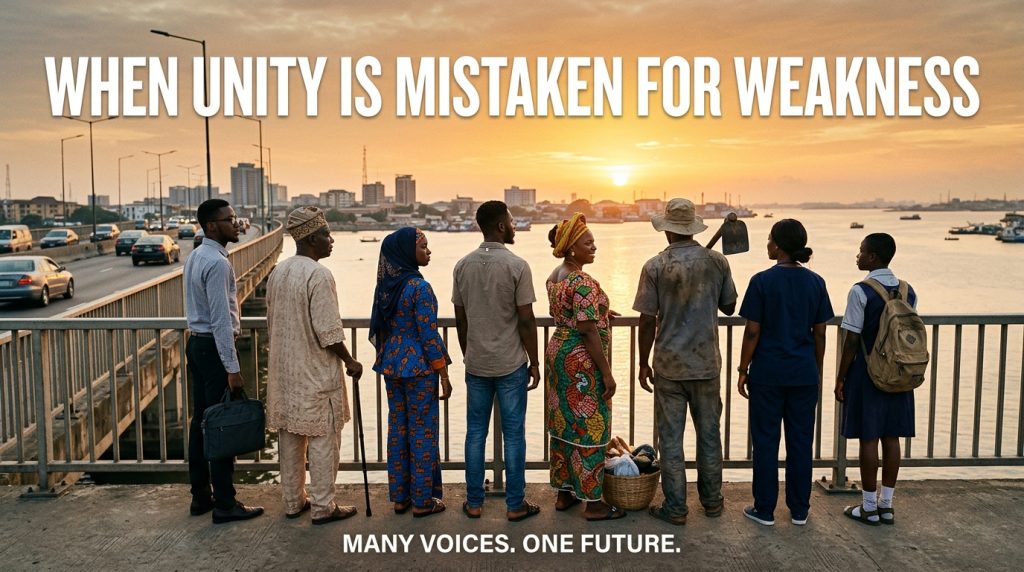
The task before Nigeria is therefore larger than winning the next election. It is preserving the nation that will exist after the election. For governments change. Political parties change. Public opinions change. But the nation remains.
And history will remember not only the leaders Nigerians elected, but also whether Nigerians themselves chose dialogue over destruction, justice over revenge, and nationhood over noise.
For that is not weakness. It is the quiet strength upon which enduring nations are built.
Anietie Udobit writes “Our Shared Nation,” a reflective column on identity, belonging, and the stories that bind Nigerians across differences.
About The Author