How the Federal High Court’s Ruling on INEC’s 2027 Timetable Could Redefine Party Politics, Defections, and Electoral Democracy
By Anietie Udobit, Abuja
Grow your business with us

Nigeria’s political landscape may have just experienced one of its most consequential judicial interventions since the return to democratic rule in 1999.
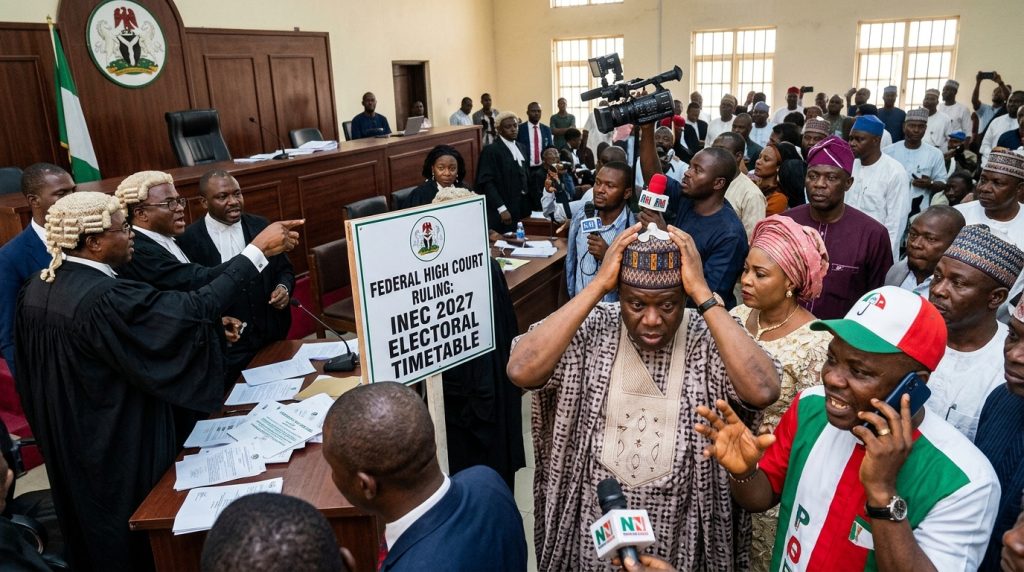
In a judgment already sending shockwaves through party headquarters, campaign structures, and political war rooms across the country, the Federal High Court struck down critical portions of the Independent National Electoral Commission’s (INEC) timetable for the 2027 general elections.
At the center of the ruling delivered by Justice M.G. Umar is a fundamental constitutional question: Can INEC, through administrative directives, restrict political rights and timelines already guaranteed by the Electoral Act 2026? The court’s answer was emphatic — no.
By nullifying several key deadlines imposed by INEC, the judgment has not only restored the supremacy of the Electoral Act but also reopened what many political observers are now calling Nigeria’s “political transfer market.”
The implications are enormous. From disgruntled governorship aspirants seeking fresh platforms to powerful party blocs preparing strategic defections, the ruling has effectively redrawn the political map ahead of 2027. What appeared weeks ago to be a closed political season has suddenly become fluid again. And for Nigeria’s fragile democracy, this development may either deepen internal democracy or trigger a new era of political instability.
The Core of the Judgment
The legal battle was initiated by the Youth Party, which challenged INEC’s authority to impose restrictive deadlines beyond what is expressly provided in the Electoral Act 2026. The court agreed substantially with that argument.
Justice Umar ruled that INEC exceeded its administrative powers by introducing timelines that effectively altered or narrowed statutory rights already guaranteed by law.
In essence, the judgment reaffirmed a critical democratic principle: electoral commissions administer elections, but they cannot legislate beyond the authority granted by Parliament.
This distinction matters profoundly. INEC’s earlier timetable had imposed a rigid May 10, 2026 deadline for parties to finalize and submit digital membership registers — a move widely interpreted as an attempt to prevent post-primary defections and stabilize party structures early.
However, the court found that such restrictions lacked legal foundation under the Electoral Act. The ruling therefore restores the broader statutory framework originally envisioned by lawmakers.
A Political Lifeline for Defeated Aspirants
Perhaps the biggest beneficiaries of the ruling are politicians who recently lost party primaries. Before this judgment, many aspirants believed their political ambitions had effectively ended. The strict deadlines created by INEC meant that once a party finalized its register, defecting to another party became practically impossible. That barrier has now collapsed. The membership registration deadline has reportedly shifted back to September 2026 under the broader provisions of the Electoral Act. This seemingly technical adjustment carries explosive political consequences.
It means politicians who lose governorship, senatorial, House of Representatives, or presidential primaries now have months — not days — to negotiate fresh political deals elsewhere.
In practical terms, Nigeria’s political “transfer season” is officially back. Aspirants who feel unfairly treated during primaries can now defect comfortably to smaller parties, update their memberships legally, and re-enter the electoral battlefield. For opposition parties struggling for relevance, this could become a recruitment bonanza. For ruling parties battling internal divisions, it could become a nightmare.
The Return of the “Peter Obi Model”
The judgment also quietly revives what many analysts describe as the “Peter Obi pathway” — a reference to the dramatic political realignment witnessed before the 2023 elections. That model demonstrated how late-stage defections could rapidly alter national political momentum. INEC’s now-voided timetable appeared designed partly to prevent such scenarios from repeating themselves in 2027.
The Federal High Court has now reopened that possibility. A major political heavyweight denied a ticket today could emerge tomorrow as the presidential or governorship candidate of another party. This flexibility fundamentally changes the strategic calculations of Nigeria’s political actors. Party leaders can no longer assume defeated aspirants are politically finished. Every failed primary candidate is now potentially a future opposition threat.
Political Parties Gain Breathing Space — and New Problems
For political parties themselves, the ruling offers both relief and danger. On one hand, parties now have significantly more time to manage internal crises, reconcile factions, and update digital membership databases. This is especially important given the chaotic nature of party administration in Nigeria, where disputes over delegate lists, parallel congresses, and factional leadership often lead to confusion.
The extended window allows parties to: reorganize membership records, resolve disputes, negotiate withdrawals, conduct substitutions, and avoid rushed administrative decisions. The Electoral Act permits candidate substitution up to 90 days before elections under specific conditions, while nomination processes can extend up to 120 days before polls.
INEC’s earlier timetable had attempted to compress these windows considerably. The court has now restored the original legal flexibility.
But there is another side. This flexibility could also intensify instability inside political parties. Aggrieved aspirants now possess stronger bargaining power. Party leaders can no longer rely on tight administrative deadlines to suppress rebellion.
If influential politicians feel sidelined, they now have enough time to defect — and potentially carry thousands of supporters with them. For dominant parties like the APC and PDP, this creates serious strategic vulnerabilities. Internal party discipline may become much harder to enforce.
Internal Democracy vs Political Opportunism
The ruling raises an uncomfortable but necessary national conversation. Does flexible political movement strengthen democracy — or weaken ideology? Supporters of the judgment argue that it protects democratic freedoms. They insist politicians must not be trapped inside parties where imposition, manipulation, and flawed primaries undermine fairness.
In that sense, the judgment empowers political participation and protects aspirants from arbitrary exclusion. Critics, however, warn that the ruling may deepen Nigeria’s already weak ideological culture. One of the longstanding criticisms of Nigerian politics is that politicians frequently switch parties based not on ideas or principles, but on personal ambition.
The judgment may unintentionally encourage this culture further. Instead of strengthening party ideology, Nigeria could witness intensified political migration driven purely by electoral survival. The consequence may be more fragmented coalitions, unstable alliances, and unpredictable political outcomes.
A Direct Institutional Challenge to INEC
Beyond politics, the ruling also represents a significant institutional challenge to INEC itself. For years, the commission has increasingly relied on administrative regulations to manage the complexity of elections.
This judgment sends a clear warning that such regulations must remain strictly within statutory boundaries. The court essentially reminded INEC that administrative convenience cannot override legislative authority. That principle is critical for constitutional democracy. However, it also places INEC in a difficult position. The commission designed the compressed timelines partly to reduce logistical confusion, curb endless litigation, and stabilize party structures early enough for election planning. Now, much of that framework has been disrupted.
INEC is widely expected to appeal the judgment immediately. And understandably so. Without a successful appeal or stay of execution, the commission may be forced into a major recalibration of its 2027 election preparations. That uncertainty could affect everything from voter education campaigns to ballot production schedules.
The Danger Ahead: Endless Litigation
Ironically, a judgment meant to strengthen democracy may also generate an explosion of political lawsuits. The extended timelines now create broader opportunities for dissatisfied aspirants to challenge party decisions in court.
More court cases mean delayed candidate confirmations, increased uncertainty, factional disputes, and possible confusion close to election periods. Nigeria’s judiciary could once again become the ultimate battlefield for political power. And history shows that prolonged pre-election litigation often destabilizes democratic confidence.
A Defining Test for Nigeria’s Democracy
Ultimately, the Federal High Court’s ruling is bigger than timelines. It is about the balance between electoral administration and democratic freedom. It is about whether political participation should be restricted for administrative orderliness or expanded for broader democratic inclusion.
The judgment may strengthen internal democracy by giving politicians fairer opportunities to contest injustice within their parties. But it may also intensify political opportunism and deepen Nigeria’s culture of unstable party loyalty.
The coming months will determine which side prevails. One thing, however, is already certain: The 2027 political race has changed dramatically. The gates that appeared shut have reopened. The alliances many thought impossible may now emerge.
Anietie Udobit writes “Our Shared Nation,” a reflective column on identity, belonging, and the stories that bind Nigerians across differences.
About The Author